Cracked or Split Trunk After Storm Winds? When It Has to Come Down
September 28, 2026
Quick Answer: A cracked or split trunk usually has to come down when the crack runs into the tree's structural wood, when the trunk has a co-dominant stem that has pulled apart at the union, or when the tree has developed a new lean since the storm. Once the wood fibers that hold a trunk upright have separated, cabling and bracing can sometimes buy time on a partial split, but they cannot rebuild the strength that was lost. A certified arborist needs to look at the depth, location, and direction of the crack, plus what the tree could hit if the rest of it lets go, before anyone can say for certain whether it stays or goes.
You went out the morning after the wind came through and found it: a long, pale seam running down the trunk of the oak or pine that's stood in your yard for decades. Maybe there's a section of bark peeled back and curling, or a wedge of wood shifted just slightly out of alignment with the rest of the trunk. It doesn't look like the tree fell over. It looks like it's still standing, mostly, and that's exactly what makes it unsettling — you don't know if you're looking at a tree that's going to be fine or one that's a few more gusts away from landing on the roof.
That gut-check reaction is worth trusting. A split trunk is one of the few tree conditions where "wait and see" is the wrong call, because the damage that caused the split doesn't heal the way a wound on a branch does. The trunk is the load-bearing column for the entire canopy above it, and once that column has a structural fracture, gravity and the next round of wind are working against it every day it's left standing.
Why This Isn't a DIY Project
WARNING: Do not attempt to remove, cut into, or "finish off" a split or cracked trunk yourself. A trunk that's already fractured is storing tension in ways that aren't visible from the ground, and a chainsaw cut in the wrong spot can release that stored energy suddenly, causing the remaining wood to kick, twist, or drop without warning. Stay clear of the area, keep kids and pets away, and treat any large split trunk as a fall hazard until a professional has assessed and secured it. This is one of the more dangerous situations in residential tree work, and it calls for the right rigging, the right cutting sequence, and someone who's done it before.
Not worth the risk. Not for a weekend project, not to save a phone call.
Even a partial split changes how a tree behaves under load compared to before the storm. A trunk that once bent as one connected unit may now flex unevenly, with one side absorbing more stress than it's built for. That's why professional assessment matters more than guessing from the ground.
When a Split Trunk Can Sometimes Stay
Not every crack is a death sentence for the tree, and a good assessment doesn't default straight to removal. A shallow, high vertical split on an otherwise healthy, well-anchored tree with a small crown can sometimes be stabilized with cabling, provided the split is recent and hasn't progressed.
The calculus changes fast once a target enters the picture. A split oak in the back of a large lot, away from the house, can sometimes be monitored over a season. That same split near a bedroom window or a play area gets a different answer, since being wrong costs far more.
What a Professional Risk Assessment Actually Looks At
A thorough assessment goes beyond a glance at the crack. It checks the extent and depth of the split, sometimes with a mallet to listen for the change between solid and separated wood, and weighs the tree's lean, root health, and any history of storm damage or pruning cuts nearby.
The target zone matters just as much as the tree itself. What sits within range if the trunk or the section above it comes down, whether that's a house, power lines, a fence, or an area people use regularly, shapes the urgency more than almost anything else about the tree.
What Removal of a Split-Trunk Tree Involves
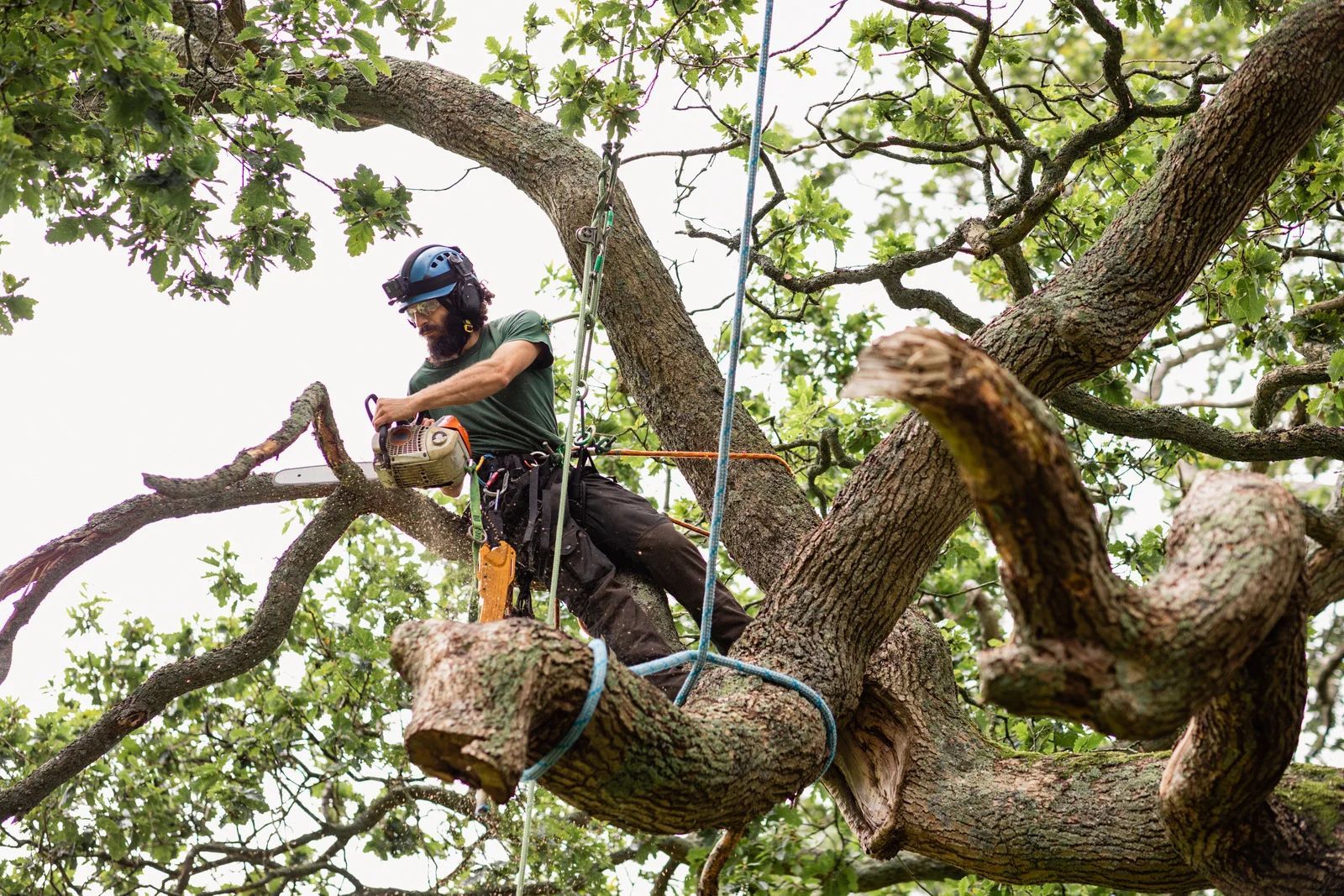
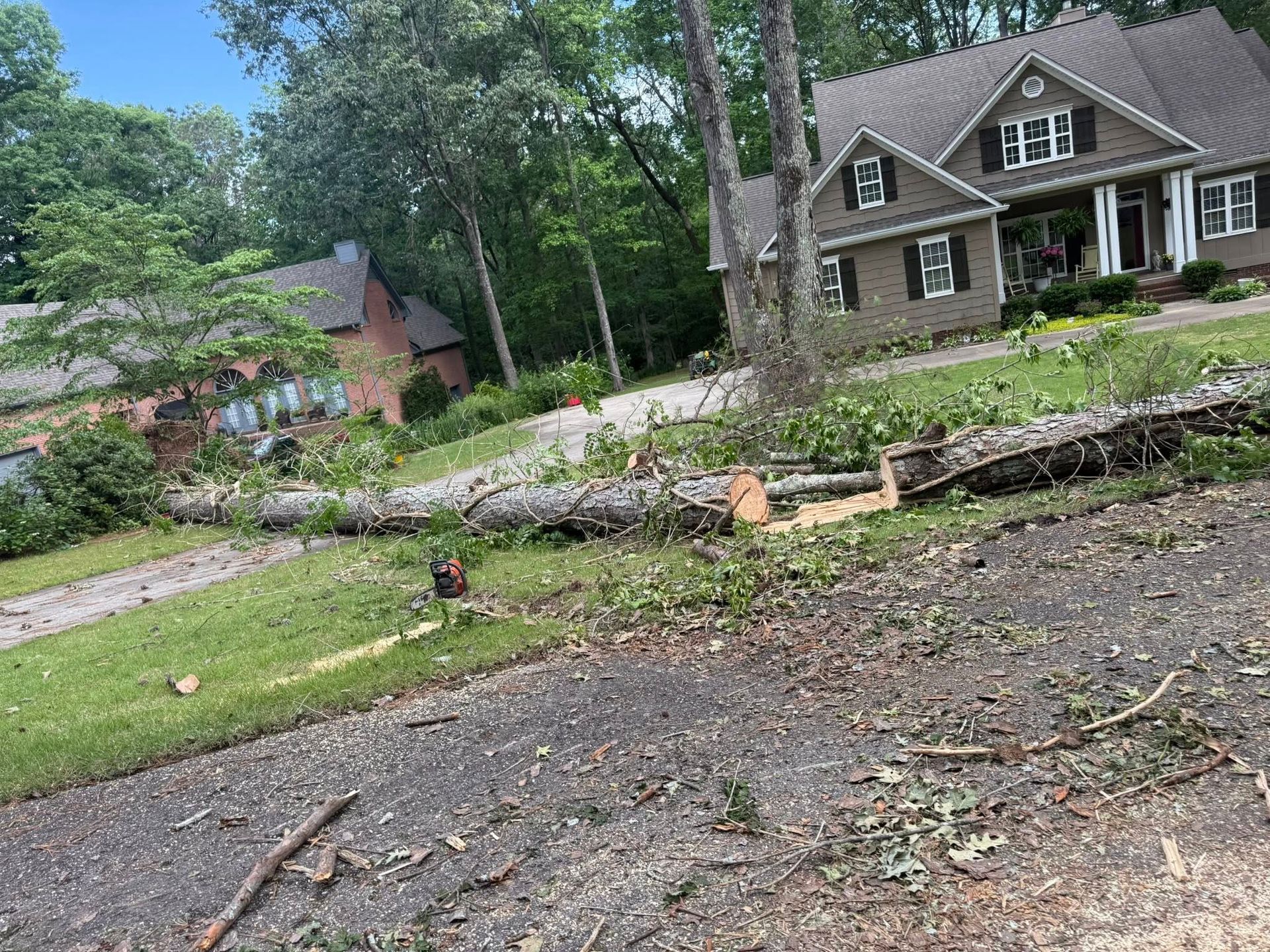
When the assessment points to removal, the process looks different from a routine takedown of a healthy tree, because the crew has to plan around wood that may fail unpredictably mid-cut. That usually means rigging sections down rather than felling in large pieces, working the crown down first to reduce the weight and strain on the compromised trunk, and controlling each cut with ropes so a piece doesn't drop or swing the moment it separates. The already-split section gets special attention, since it's the part most likely to behave differently than solid wood under a chainsaw. Debris management matters too, since there's often already downed limbs and splintered wood scattered around the base before work even begins, and a clean, methodical removal clears all of it along with the tree itself.
After the Tree Comes Down
Once a split-trunk removal is done, it's worth looking at the rest of your trees with the same eye you just used on the one that failed. Storms that split one trunk often stressed every tree on the property, and a co-dominant stem or an old topping cut on a neighboring tree that held up this time might not hold up next time. A walk around your yard after any significant wind event, checking for new leans, fresh cracks, or branches that look different than they did last week, catches the next problem while it's still small.
Stump removal is also worth deciding on soon if the split tree is gone, since a stump left in place can send up suckers and roots from a removed tree can keep interacting with nearby plantings, sidewalks, or foundations longer than people expect. Handling the stump while the crew is already on site is usually more efficient than scheduling it separately.
Frequently Asked Questions
How can I tell if a crack in my tree's bark is serious or just cosmetic?
A cosmetic wound stays shallow, limited to bark, and won't shift with wind. A serious split reaches solid wood, may open and close as the crown moves, and often brings a new lean. When unsure, assume structural damage.
Can a split trunk heal on its own over time?
No. Trees seal wounds by growing new wood around an injury's edges, but that only covers the damage, it doesn't restore lost strength. A split trunk stays structurally compromised at that point even while the rest keeps leafing out normally.
Is it always obvious from the ground how bad a split is?
Not always. A crack visible from outside can represent a far larger internal failure, especially where decay already exists. That's why a hands-on assessment, sometimes using sounding techniques or a resistance tool, gives a more accurate picture than a glance alone.
What's the difference between cabling a tree and removing it?
Cabling adds support, usually high in the crown, limiting how far a weak union or split can move under load. It suits trees with a limited defect and low risk nearby. Removal becomes necessary once the trunk's strength is too far gone.
My tree split partway but is still standing and green. Does it really need immediate attention?
Yes. A tree can look completely healthy in the canopy, full leaves and normal color, while a structural failure sits at the trunk unrelated to overall vigor. Stored energy keeps leaves going, but it says nothing about the trunk's remaining strength.
Should I try to brace or support a split trunk myself while I wait for an assessment?
No. Bracing or wedging without a proper assessment can shift load onto the wrong section or create false security about wood still moving under wind. The safest step while waiting is keeping people, pets, and vehicles clear of the area.
How quickly after a storm should a split trunk be evaluated?
As soon as it's safe, ideally within a few days. Splits exposed to weather take on moisture, which speeds up decay and insect activity and worsens the tree's condition over time. This matters even more if the split leans toward a structure.
If the split tree comes down, will it damage my lawn or landscaping during removal?
A professional crew plans the takedown carefully, lowering sections in a controlled way instead of letting them drop, and laying protective boards over turf or hardscape in the work path. Some disturbance under a large removal is normal, but planning keeps it contained.
What a Split Trunk Actually Is
A split trunk is different from a surface wound. Bark can be scraped, gouged, or torn away by flying debris and the tree will usually seal over that injury and keep growing just fine, provided the wood underneath is still intact. A split means the solid wood of the trunk itself has separated along the grain, usually because a sudden lateral force — a wind gust shoving the crown sideways while the base stays anchored — twisted or bent the trunk past what the fibers could stretch and hold.
Wood handles tension and compression well on its own, but it's weak when those two forces pull against each other at the same point, which is exactly what happens when a heavy, leafed-out crown gets shoved sideways in a gust. The wood on one side stretches, the wood on the opposite side compresses, and once the load is severe enough, the fibers in between give way. That pale seam is the visible edge of a fracture that may run several feet down into the trunk, well below what you can see from the ground.
Why Storm Winds Go After the Trunk
Not every tree splits the same way in a storm, and there's usually a structural reason a particular tree failed while its neighbors didn't. The most common setup is a co-dominant stem — two trunks of roughly equal size growing from the same base instead of one central leader with side branches. Where those two stems meet, they're rarely fused into one solid piece of wood the way they look from a distance. Bark often gets trapped in the seam between them as both stems grow, called included bark, and that trapped bark keeps the two stems from ever knitting into a single, unified column. It's a weak, glued-together joint standing in for what should be solid wood, and it's exactly the kind of joint that opens up under wind load.
Trees that were topped or heavily cut back years ago carry a related risk. Topping forces a cluster of new shoots to sprout from the cut point, and those shoots attach to the old wood with the same kind of weak, layered union as a co-dominant stem. Add years of decay working inward from an old pruning wound, and you have a trunk that looks full and healthy in the crown while carrying a hidden defect right where the load concentrates.
Tip: If you're not sure if it's a shallow bark wound or a structural split, don't press on it or pull at loose bark to check. Take a few photos from a safe distance and note whether the crack runs vertically along the grain or at an angle, since that detail helps an arborist judge how far it likely extends before anyone puts a hand on the tree.
Reading the Signs That Matter
Depth matters most. A split affecting only the outer inch or two of wood, especially on a large-diameter tree, leaves plenty of sound wood carrying the load. A split running deep toward the center has already taken out structural strength.
Location matters just as much. A split low on the trunk, near the root flare, is more serious than the same length higher up, since that section carries everything above it. A split near a branch union compounds the weakness.
Movement is the other tell. Daylight opening and closing in the crack, or the trunk's sides shifting since the storm, means that section is flexing in a way solid wood shouldn't. A new lean since the storm signals lost strength.
Knowing When a Split Trunk Must Go
A split trunk rarely announces itself the way a downed limb does. The tree can still hold its leaves while the wood underneath carries a fracture that only worsens with time and weather. What separates a tree that can be saved from one that has to come down isn't how it looks from the porch. It's what a trained eye finds when checking the depth, the direction, and what stands to be hit if that column finally gives way.
Altitude Tree Service, LLC
has spent 10
years
assessing storm-damaged trees around Huntsville, Alabama, and that experience shapes how each trunk gets read, whether the split is shallow enough to monitor or deep enough to demand immediate removal. Every yard holds a different answer, shaped by species, root health, and what sits within reach if the tree lets go. A cracked trunk left alone rarely gets safer on its own, and the sooner it's looked at, the more options usually remain on the table.